The problem: Every operator knows guests run the AC at extreme settings and leave it on in an empty room. The common reaction is to take control away from the guest by capping, disabling, or physically caging the remote.
What we did: We looked at a real example, a remote bolted inside a metal box in a central Madrid hotel, and broke down exactly what that approach fixes and what it misses.
What we found: Capping the setpoint removes the extreme-cold portion of the waste but not the other part, the hours of runtime in an empty room, which only switching the unit off can recover. It also makes the cost-cutting visible to the guest, which quietly damages reviews, comfort and trust.
What it means in euros: The recoverable waste is €190–450 per AC unit per season, and most of it sits in runtime, not setpoint. You can remove all of it without the guest ever feeling controlled. A hotel with 50 rooms and 50 AC units recovers €9.500–22.500 a season.
Locking guests out of the AC controls does cut some waste. It also taxes the one thing guests are paying for: a comfortable room and the feeling of being trusted in it. The waste actually worth removing is the empty-room runtime, worth €190–450 per AC unit per season, and you can remove it without a guest ever noticing.
The short answer
A physical lockbox over the remote is a reasonable instinct that solves only one half of the problem. It stops a guest setting 16°C, which matters, but it does nothing about the unit running for hours in an empty room, because a cap can only turn the unit down, never off. And it solves that one half in the most visible way possible, by advertising to a paying guest that they are not trusted. The better answer is to cap the extreme settings and stop the unattended runtime, quietly, while leaving the guest in full control of their own comfort.
A real example, bolted to the wall
This June, in a hotel in central Madrid, the AC remote was fixed to the wall inside a powder-coated metal box. The box had a cutout that exposed only some of the buttons. The minimum temperature was capped at 18°C rather than the usual 16°C. The battery compartment was sealed inside the housing so guests could not remove the batteries. On arrival, after the room had been prepared, the AC had been switched off entirely, so the room was hot.
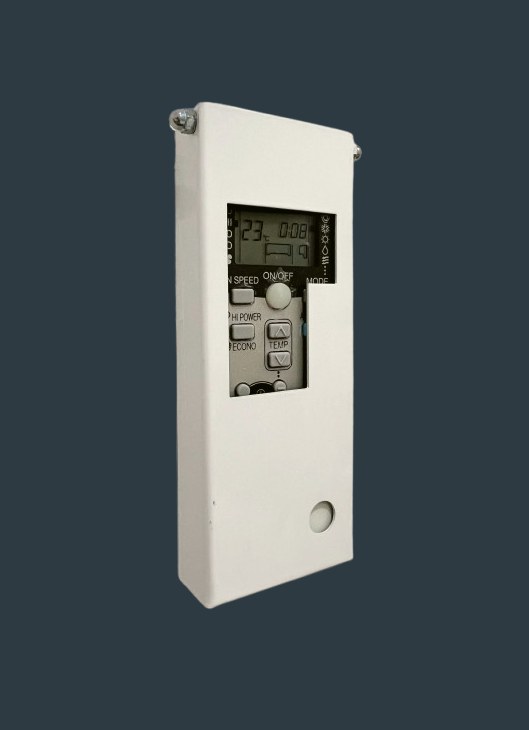
The property is a 9-room, independently run hotel in central Madrid. Nine rooms, nine AC units, and because this is Madrid the same units heat the rooms in winter and cool them in summer, so the waste runs year-round and Narveo limits both. Modelled, the saving works out at about €300–400 per AC unit a year, so roughly €2.800 across the nine units (€2.500–3.300), the revenue of about three fully booked nights and around 2,7 tonnes less CO₂. The telling detail: across the hotel's guest reviews, the air conditioning barely registers. The cage is not generating complaints, which is exactly why the missed saving stays invisible.
Figures come from the narveo.eu savings calculator (1,2 kW average split unit, 35% recoverable waste, €0,25/kWh, 0,24 kg CO₂ per kWh) at a realistic ~14–15 hours a day of runtime. Because Madrid is continental, the same unit cools in summer and heats in winter, so the figure counts both seasons: about €300–400 per AC unit a year. Coastal, cooling-only properties (Ibiza) run roughly half that. Every figure is modelled and varies with occupancy, season and tariff.
It is easy to laugh at, but it deserves respect. Somebody designed it, had it fabricated, and screwed it to the wall in a guest room. That is not a hypothetical pain point. That is an operator paying for a custom metal part because nothing off the shelf solved their problem. The instinct is completely right. Guest-driven AC waste is real and it is expensive. The question is whether a cage is the best tool for the job, and what it costs you beyond the metal.
What the cage fixes, and what it misses
Guest AC waste comes in two parts. The first is the extreme setpoint: the guest who walks in and presses the temperature down to 16°C because the room is hot and lower feels faster. At 16°C, energy use can rise by up to 70% compared with a 24°C setting. The second is runtime: the unit left running for hours while the guest is at the beach, at lunch, or out for the evening.
The Madrid lockbox addresses the first part. An 18°C floor stops the very coldest settings. But it does nothing about the second part: a cap turns the unit down, it never switches it off. A guest can still switch the caged remote on at 18°C in the morning and leave it running in an empty room until midnight. The cage cannot tell whether anyone is in the room. It only limits the number on the display.
- Stops 16°C settings, caps the floor at 18°C
- Blocks a few buttons and hides the batteries
- Does nothing about empty-room runtime: it caps the number, it never switches off
- Visible to the guest, reads as distrust
- Sometimes paired with switching the AC off at turndown, so guests arrive to a hot room
- Caps the minimum temperature, no extreme settings
- Auto-shuts off after a set time, so empty-room runtime ends on its own
- Guest keeps the remote and full comfort control within limits
- Invisible: the saving happens without a confrontation
- Room can stay comfortable for arrival, the limit handles the waste
This is the heart of it. A setpoint cap is a thermostat fix: it tidies the number on the display but leaves the unit running. Stopping empty-room runtime needs a control a thermostat cap does not have, an automatic shutoff.
The hidden bill: the doorman fallacy
There is an old consulting trick. You walk into a hotel and ask what the doorman costs. You define the doorman's job as opening the door. You replace him with an automatic door, claim every euro of the saving, and walk away. Five years later the rack rate has slipped, the regulars have drifted off, and nobody connects the decline to the missing doorman, who in reality hailed taxis, recognised guests, and made the entrance feel safe. The saving was easy to measure. The value destroyed was not, so it went on nobody's account.
Supermarket self-checkout is the same move. As an option for a quick basket, it is fine. Once finance notices it is cheaper to make the customer do the work, the option quietly becomes the obligation, and the cost lands later as a worse experience and more shrinkage. The person who booked the saving is never the person who pays for the lost value.
A metal cage over the AC remote is the doorman fallacy in powder-coated steel. The saving is easy to see on the energy bill. The cost is hard to see and lands somewhere else: the guest who feels policed, the review that mentions a hot room and a locked controller, the booking that does not repeat. In a room a guest is paying to enjoy, a visible restriction is not free. It just bills you later, in a currency that does not show up on the meter.
Why the human side is worth protecting
In service businesses, the human experience tends to outweigh almost everything else in how guests judge a stay. It is also the hardest thing to measure, which is exactly why cost-cutting tramples it. A caged remote and a switched-off unit on arrival save a measurable amount of electricity and cost an unmeasured amount of goodwill. The electricity shows up this month. The goodwill shows up in the rating and the rebooking, long after the decision was made.
The useful idea here is that different is better than better. You do not win by being a slightly harsher version of every other operator capping the controls. You win by removing the waste without the guest ever feeling it, so the room stays comfortable and the bill still falls. That is a different posture, not a tighter one.
The operator's way through
Narveo was built by a vacation rental operator in Ibiza, after years of watching guests leave the AC running at 16°C all day, and it is still used in the founder's own properties. The design choice follows directly from the doorman problem. Instead of taking the controls away, Narveo caps the minimum temperature and auto-shuts off after a set time. The extreme setpoint is gone. The empty-room runtime ends on its own. The guest keeps the remote and full comfort control within efficient limits, so there is nothing to feel policed by and nothing to fight.
It sets up in under 2 minutes, costs €69 per unit, and works with 6.000+ AC codes. No app. No WiFi. No installation. The room can stay comfortable for the guest's arrival, and the limit, not a sealed box, takes care of the waste.
- A physical lockbox over the AC remote is a real operator instinct, but it fixes only the setpoint half of the problem and advertises distrust to a paying guest
- Guest AC waste has two parts: extreme setpoint and empty-room runtime. A setpoint cap addresses only the first; it never switches the unit off, so the empty-room hours run on untouched
- Capping the minimum at 18°C still lets a guest run the unit all day in an empty room, so the entire empty-room runtime survives the cage
- Visible cost-cutting carries a hidden bill, the doorman fallacy: easy-to-measure savings now, hard-to-measure damage to reviews, comfort and rebookings later
- The recoverable waste is €190–450 per AC unit per season, and you can remove it invisibly rather than only the setpoint half, visibly
- Narveo caps the minimum temperature and auto-shuts off after a set time, leaving the guest in comfort while the waste stops on its own
FAQ
When Narveo is not the right solution
Narveo is designed for warm-climate rentals and hotels where split AC units run continuously through a four-to-six month peak season. Properties in cool climates, where guests rarely use the AC during the day, will see proportionally less return. Narveo is not compatible with ducted or centralised BMS systems. It is also not suited to owner-occupied properties where usage is already self-managed and tightly controlled.
Stop the waste without caging the guest.
Narveo caps the minimum temperature and auto-shuts off after a set time. Guests keep full comfort control. No app. No WiFi. No installation. Pilot Narveo in 25% of your rooms, minimum 5 units, and recover €190–450 per AC unit this season.
Reserve yours · €69