The forecast. Meteorologist Brian Shields of Mr. Weatherman Europe published a 46-day outlook on 21 May 2026 placing Spain and Portugal 2–3,5°C above the June monthly average. A dominant high-pressure system keeps conditions hot and dry. El Niño, currently in a stronger-than-average phase, increases the likelihood of prolonged heat events lasting three to ten days.
The problem. A hotter June is not just uncomfortable. Each degree above the seasonal norm adds compressor runtime across every AC unit in a rental property. We have documented the structural reasons behind this in our EU cooling demand article and the grid pressure whitepaper. This article focuses on what the June 2026 forecast specifically means for operator bills.
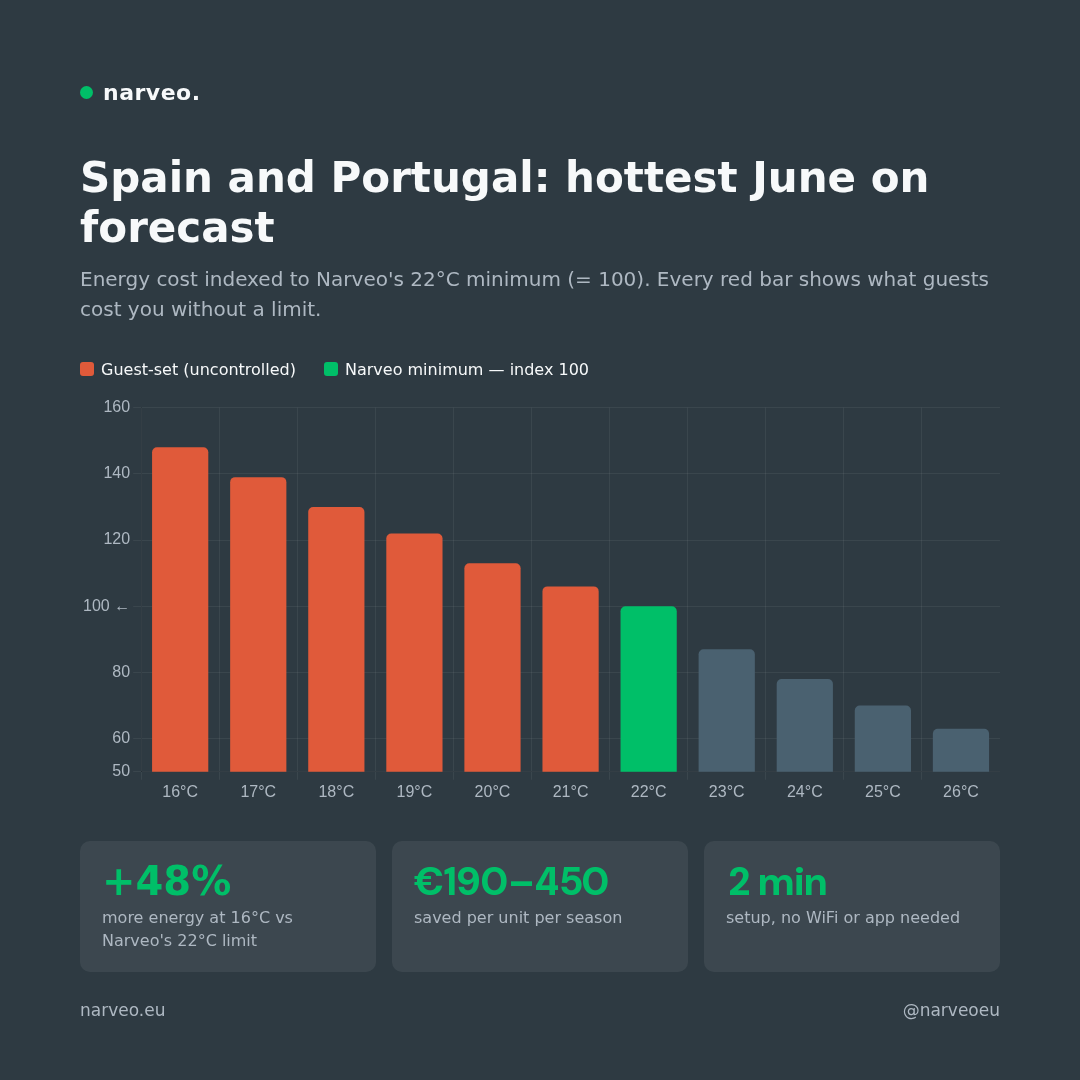
What we know. Guest behaviour makes a hot month significantly more expensive. Our Mediterranean setpoint research shows guests routinely push thermostats to 16°C when outdoor temperatures rise. A guest who sets 16°C and leaves the room can increase that unit's electricity consumption by up to 70% compared with a guest who sets 22°C.
What it means in euros. For a 5-unit rental property, a June that runs 3°C above average is estimated to add around €150–180 to AC electricity costs compared with a typical year. If guests are running units at 16°C unattended through a heat spell, that figure roughly doubles. A minimum temperature limit set before the heat arrives caps the damage.
A June that runs 3°C above average in Spain and Portugal costs more to run than a typical June. That much is straightforward. The less obvious part is how the costs compound when hotter weather collides with the way most guests use air conditioning during a heatwave. For a rental portfolio without temperature controls in place, an above-average June is an uncontrolled cost.
What the June 2026 forecast actually says
On 21 May 2026, Brian Shields of Mr. Weatherman Europe published a 46-day temperature and precipitation outlook covering June and early July. The key finding for the Iberian Peninsula: temperatures across Spain and Portugal are expected to run 2–3,5°C above the monthly average, driven by persistent high pressure and well below-average rainfall across much of western and central Europe.
The forecast is reinforced by a stronger-than-average El Niño cycle currently active in the Pacific. Shields was specific about the concern: not individual hot days, which pass quickly, but prolonged heat events where temperatures fail to recover overnight. These are the events where you are locked into three, four, five, even upwards of ten consecutive days of heat. Those are the conditions that push AC systems hardest and where electricity costs accumulate fastest.
Most of Europe skews warmer than average through June. Exceptions exist: the Balkans, Turkey and Scandinavia are forecast below average, and coastal Norway will see wetter conditions. But for operators in Spain, Portugal and the broader Mediterranean basin, the direction is clear.
What hotter temperatures do to AC bills
Air conditioning systems do not scale linearly with outdoor temperature. The compressor works harder as the gap between indoor set point and outdoor temperature widens. A room trying to maintain 22°C when it is 32°C outside requires significantly more energy than the same room on a 27°C day. The relationship is steeper than people expect.
Based on cooling degree day modelling for Spanish rental properties, a June that averages 3°C above normal is estimated to increase AC electricity consumption by 35–50% compared with a typical year, assuming the same usage pattern. That assumption, however, is the problem: usage patterns do not stay the same when it gets hotter. Guests respond to heat by pushing thermostats lower.
Why this June is worse than a normal hot month
The El Niño angle matters specifically for the duration of heat events, not their intensity. A single hot day is expensive but manageable. The scenario Shields described is a week or more where overnight temperatures stay high, the property never cools down fully, and guests arrive each day into a room that has been warming all night. Their instinct is to set the coldest available temperature and leave the unit running.
We have covered the structural backdrop to this in more depth elsewhere. Our EU cooling capacity article explains why European grids, built for a pre-AC era, are under increasing stress during summer peaks. Our grid pressure whitepaper documents the supply-side constraints. The short version that matters to operators: on the hottest afternoon of a prolonged heat event, you are likely paying more per kilowatt-hour at the exact moment your units are working hardest, if you are on any form of variable tariff.
A week where guests run AC at 16°C through a sustained heat spell is not a worst case scenario. It is what happens by default when there are no controls in place.
The 16°C problem, in context
Our Mediterranean setpoint research documents this in detail, so we will not repeat it here. The summary relevant to June 2026: the hotter it gets outside, the lower guests set the thermostat. At 16°C, the compressor does not cycle, it runs continuously. The unit is not maintaining a temperature; it is fighting the ambient heat at maximum draw. The electricity cost is not proportional to the 6°C difference between 16°C and 22°C. It is the difference between a unit that cycles normally and one that runs flat out.
For a rental property running five units through a five-day heat spell where guests are at 16°C, the electricity cost increase versus controlled usage is not a rounding error. It sits in the range of €80–150 for that week alone, depending on hours and tariff.
What operators can do before June
There is roughly a month between this forecast and the period it describes. Two practical controls can be set in that time, on each unit, in under two minutes each.
The first is a minimum temperature limit. Setting the floor at 20°C stops the compressor from running flat out while still keeping rooms comfortable. Guests can still lower the temperature, they just cannot take it below a level that makes operational sense. The unit does its job. It does not do twice the work for no benefit.
The second is daytime auto-off scheduling. Defining a shutoff window in the hottest hours of the afternoon targets the peak usage period. Guests who have left the property for the day are the largest single source of avoidable runtime. In a prolonged heatwave, those hours also coincide with the highest grid demand and the highest spot prices.
Neither requires WiFi, an app or an electrician. Narveo replaces the existing AC remote and applies both controls through the remote itself. Setup takes under two minutes per unit. At €69 a unit, the break-even against an above-average June is a matter of weeks, not seasons.
5-unit property, typical hot season: €190–450 per unit in avoidable AC electricity costs per season, based on Narveo operator data.
A 3°C-above-average June alone: estimated €150–250 in additional AC costs above a typical year, before accounting for guest behaviour at 16°C.
With Narveo minimum temperature limits: 30–50% reduction in AC electricity costs. At five units, that recovers the hardware cost within the first month of operation.
- Spain and Portugal are forecast 2–3,5°C above the June monthly average, with El Niño raising the likelihood of prolonged heat events lasting 3–10 days.
- A 3°C-above-average June is estimated to increase AC electricity consumption by 35–50% compared with a typical year, on the same usage pattern.
- Guests consistently push thermostats to 16°C during heatwaves; this can increase a unit's electricity draw by up to 70% versus a sensible setting of 22°C.
- Europe's electricity spot market prices spike precisely when AC demand is highest, adding a cost-per-unit layer on top of higher consumption.
- A minimum temperature limit and daytime auto-off schedule set before the heat arrives are the two controls with the most direct impact on the bill.
- At €69 per unit with a 30–50% cost reduction, payback against an above-average June is typically within the first few weeks of operation.
Frequently asked questions
- Brian Shields, Mr. Weatherman Europe. June 2026 outlook, temperature, precipitation and El Niño update. YouTube, 21 May 2026. @MrWeathermanEurope
- Narveo. Europe is running out of cooling capacity – and rental operators are on the front line. May 2026.
- Narveo. Cooling Europe without overloading the grid. White paper, 2026.
- Narveo. Cooling setpoint and electricity use in Mediterranean mini-split air conditioners. White paper, 2026.
- Narveo. AC savings methodology: how Narveo reduces energy use by 30–50%. White paper, 2026.
- Cooling degree day adjustment based on IEA methodology. Temperature scenarios modelled; not empirical data for June 2026.
Set limits before the heat arrives
Under 2 minutes per unit. No app. No WiFi. No installation. €69 each, pays back within weeks of an above-average season.
Reserve Narveo